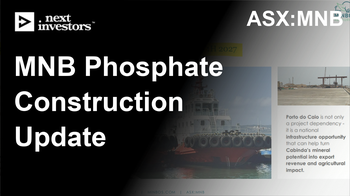
Angola imports the overwhelming majority of its Fertiliser, and the government has designated MNB's project as being of national importance. (source)

ASX:MNB
Minbos Resources Ltd

ASX:MNB
- Minbos Resources Ltd
$0.012
Last Price
Investment Memo:
Minbos Resources Ltd (ASX:MNB)
- LIVEOpened: 20-Jul-2026
Shares Held at Open: 43,618,834
Options Held at Open: 39,378,833
What does MNB do?
Minbos Resources (ASX:MNB) is building Angola's only integrated phosphate mine and fertiliser plant - the Cabinda Phosphate Project.
MNB also owns the Capanda Green Ammonia Project, which has access to some of the cheapest hydroelectric power in the world.
What is the macro theme?
Minbos Resources (ASX:MNB) is building Angola's only integrated phosphate mine and fertiliser plant - the Cabinda Phosphate Project.
MNB also owns the Capanda Green Ammonia Project, which has access to some of the cheapest hydroelectric power in the world.
Our Big Bet for MNB
"MNB re-rates to a $200M+ market cap by completing construction of its Phosphate Project, moving into production and generating its first fertiliser sales - and/or attracts a strategic investment or takeover bid at multiples of our Entry Price."
NOTE: our “Big Bet” is what we HOPE the ultimate success scenario looks like for this particular Investment over the long term (3+ years). There is no guarantee that our Big Bet will ever come true. There is a lot of work to be done, many risks involved, including development risk, country risk and commodity price risk - just some of which we list in our MNB Investment Memo.
Why did we invest in MNB?
The Angolan government labelled MNB's project "nationally important"
Angola's Sovereign Wealth Fund is a shareholder
The Angolan Sovereign Wealth Fund (FSDEA) is a shareholder in MNB's project.
The sovereign wealth fund owns 22% of MNB's project - investing US$10M into the asset at a look through valuation of ~US$45M back in 2024. (source)
When the country's own sovereign wealth fund is aligned with MNB shareholders, we think the usual "African project" financing and permitting risks look different.
The FSDEA has also formed a joint task force with MNB to help secure additional working capital for the ramp up. (source)
Definitive Feasibility Study (DFS) with strong economics
MNB's phosphate fertiliser project's Definitive Feasibility Study (DFS) shows the project could generate ~US$55M in EBITDA per year (base case, on average) over a 20 year mine life.
(NOTE* this study is now 4 years old, so the numbers could look very different nowadays. We only use it to form a basis for the technicals of the project)
The hard part is done - civils complete, final build contract signed
~US$33M has been put into MNB's project to date. (source)
MNB's platform, roads, drainage, slabs and foundations are now COMPLETE. (source)
MNB has signed a US$13.8M Phase 2 construction contract covering ALL remaining works to take the plant to dry commissioning.
(dry commissioning is when you switch a plant on and test everything works - before feeding in the real material)
After years of delays, the build funding is secured
MNB's now secured:
- ✅ US$10M equity from the Angolan Sovereign Wealth Fund (FSDEA) - received in full. (source)
- ✅ US$16M loan from the Industrial Development Corporation (IDC) of South Africa - the first US$4.8M drawdown was received a few weeks ago. (source)
- ✅ Today's $4M capital raise at 1.5c (which we participated in)
- 🔄 A Term sheet signed with Banco de Fomento Angola (one of Angola's largest and most established commercial banks) for ~US$5.48M. (source)
With build financing now secured, MNB is in a position to FINISH the build - which is already well underway.
The plant is already bought, paid for, and sitting in country
MNB's plant was designed and shipped to Angola back in 2023 - it has been sitting in storage a short drive from the site ever since.
(we saw the plant parts with our own eyes on our site visit in February 2023)
Fertiliser sold inside Africa carries an "inland premium" and MNB's product has been tested in country
Angola has some of the best uncultivated arable land in Africa, a government hell-bent on food security, and almost no domestic Fertiliser production.
And Fertiliser sold within Africa captures what's known as the "Africa inland premium" - imported product carries heavy shipping and logistics costs, which a local producer pockets instead.
The product MNB plans to produce has been tested in 70+ field trials inside Angola over 7 years improving crop yields by 60-110%. (source - Page 10 of the presentation)
MNB can produce a product that domestic and export customers want
MNB has 15+ engaged potential customers, 3 in trial-stage, 6 domestic buyers with Letter Of Intent's signed and 1 committed export offtake partner. (source)
MNB has also signed a Heads of Agreement with Fertiafrica for granulation services at its Benguela facility - which would produce the first locally granulated fertiliser in Angola's history, using MNB rock as the prime ingredient. (source)
(granulation = turning fertiliser into the small, round, spreadable pellets farmers actually use)
MNB is moving into production now
MNB has spent four years stuck in the trough of the "Lassonde Curve" - the stage between discovery and production where share prices generally tend to drift lower.
We think MNB is now in a position to re-rate higher as it moves into production:
(BONUS REASON) MNB also has a green ammonia project
MNB also has a Green Ammonia Project - with access to hydroelectric power at ~US$0.004 per kilowatt hour, some of the cheapest electricity on earth.
In October 2025, MNB signed an agreement with a modular ammonia plant company to jointly develop the project and lodge a joint bid into a major European green ammonia procurement process. (source)
We have covered that project in detail before here: What is MNB's Green Ammonia Project?
MNB's gone quiet on this one for now, but we think that once the fertiliser project is up and running it could come to the front again.
We think MNB's current valuation isn't really placing any value on that project.
What do we expect MNB to deliver?
Objective #1: Complete Phase 2 construction
We want to see the plant assembled and reach dry commissioning.
Milestones
 Civil works complete
 Structural steel and mechanical installation
 Electrical, instrumentation and process control installed
Dry commissioning achieved
Objective #2: Complete the funding package
We want the full project funding closed out to cover construction AND ramp-up to full operations ("wet commissioning").
Milestones
Transfer of Mining Investment Contract and Mining License
US$10M FSDEA equity received
US$16M IDC loan signed, drawdowns underway
US$5.48M Banco de Fomento Angola facility formalised
Working capital facility secured (FSDEA joint task force)
Objective #3: First production and first sales
We want to see the plant wet commissioned, first product produced, and first revenue banked.
Milestones
Wet commissioning
THE photo: the first sack of Angolan-produced phosphate Fertiliser
First shipment to a customer (including any early unprocessed rock sales)
Binding offtake agreement(s) converted from existing MoUs/HOAs
First revenues reported
Objective #4: (BONUS): Green ammonia project progressed
After the phosphate project is up and running, we would like to see MNB go back and progress the green ammonia project.
What could go wrong?
Permitting risk
MNB has previously mentioned that the transfer of the Mining Investment Contract (MIC) and Mining Licence to MNB's local subsidiary gates early mining and local sales. MNB's announcement today said that this would be one of the next catalysts to come. There is no guarantee this permitting roadblock is resolved.
Construction and commissioning risk
This is the big one right now. Plants rarely bolt together on time and on budget, and commissioning a first-of-its-kind-in-country plant can surface problems that take months to fix. Any delay would likely hit the share price hard given MNB's history.
Funding and dilution risk
MNB has needed repeated equity raises through the development phase, including at deep discounts. If the BFA facility or working capital lines are delayed, or construction runs over budget, MNB may need to raise again at unattractive prices.
Sovereign risk
The project is in Angola. Government support is strong - but bureaucracy is slow, legal processes are underdeveloped, and the mining licence clerical saga showed how administrative issues can spook the market even when resolved.
Offtake and payment risk
MoUs and HOAs are not binding offtake contracts. MNB needs to convert customer interest into signed agreements - and then actually get paid on time by counterparties in a developing market.
Commodity price risk
The project's economics are leveraged to phosphate and Fertiliser prices, which are cyclical and can move quickly in both directions.
Delay risk
MNB has missed timelines before. Even small slips against the new construction schedule could be punished disproportionately.
Other risks
Like any small-cap resources development company, MNB carries significant risk, here we aim to identify a few more risks.
Although the core civil works are finished, the company faces logistical risks in safely transporting the stored plant components to the site and assembling them. Developing infrastructure in emerging markets like Angola can often lead to unforeseen transport bottlenecks or inflated supply chain costs during final installation.
The recent appointment of a new CEO highlights a critical transition from the engineering phase to the operational phase. Any friction during this leadership handover or a shortage of operational experience in the region could severely stall the project's commercial ramp-up.
Operating and selling fertiliser inside an emerging market introduces significant exposure to local currency volatility and macroeconomic shifts. Unfavorable exchange rate movements or stringent capital repatriation controls could restrict MNB's ability to service its foreign-denominated loans or return profits to shareholders.
Investors should consider these risks carefully and seek professional advice tailored to their personal circumstances before investing.
What is our investment plan?
We have been Invested in MNB since taking a position at 3c in August 2020. Since then, MNB hit a peak of 18.5c in March 2022 before the share price began to trend back to its 1.5c level.
While the share price is off its peak, we are holding for further re-rates as project construction is completed, offtakes are signed, phosphate production begins, and progress is made on the green hydrogen/ammonia side of the business.
Disclosure: Disclosure: S3 Consortium Pty Ltd (the Company) and Associated Entities own 43,618,834 MNB Shares and 39,378,833 MNB Options. Some Shares and Options are subject to shareholder approval. The Company has been engaged by MNB to share our commentary on the progress of our Investment in MNB over time. This information is general in nature about a speculative investment and does not constitute personal advice. It does not consider your objectives, financial situation, or needs. Any forward-looking statements are uncertain and not a guaranteed outcome.
Investment Memo:
Minbos Resources Ltd (ASX:MNB)
- LIVEOpened: 19-Dec-2022
Shares Held at Open: 8,644,973
What does MNB do?
Minbos Resources (ASX: MNB) is seeking to build high-margin phosphate fertiliser supply business with the potential to dramatically transform Angola’s food security and crop yields.
MNB is also seeking to develop a green hydrogen/ammonia business powered by cheap hydro-electric power that would cut the reliance on natural gas in producing ammonia, also located in Angola.
What is the macro theme?
MNB is targeting phosphate production for fertilisers, as well as green ammonia for use in fertilisers and in explosives.
These two products each have strong tailwinds supporting high prices and ongoing demand. Fertiliser prices are at near record highs and food security is an increasingly important global issue.
Angola is a potential agricultural powerhouse and MNB is positioning itself as one of the very few local fertiliser product producers in the region.
Green ammonia, used in fertilisers and explosives for mining companies, is to be made with hyro-electric power, reducing the reliance on high priced natural gas and without the carbon footprint.
Our Big Bet for MNB
"MNB re-rates to a $200M+ market cap by completing construction of its Phosphate Project, moving into production and generating its first fertiliser sales - and/or attracts a strategic investment or takeover bid at multiples of our Entry Price."
NOTE: our “Big Bet” is what we HOPE the ultimate success scenario looks like for this particular Investment over the long term (3+ years). There is no guarantee that our Big Bet will ever come true. There is a lot of work to be done, many risks involved, including development risk, country risk and commodity price risk - just some of which we list in our MNB Investment Memo.
Why did we invest in MNB?
Short timeline to high-margin phosphate production
Armed with a robust DFS, and with construction underway, we look ahead to first production at MNB’s phosphate project in late 2023. The project is leveraged to fertiliser prices, so the forecast high fertiliser prices and supportive supply-demand dynamics should support the years ahead will work to benefit the project.
Capanda green ammonia project
MNB is exploring green hydrogen / green ammonia production potential in Angola. It is leveraging its support from the Angolan government to ensure access to the country’s local hydro-electric power at what may be the world’s cheapest energy rates.
What do we expect MNB to deliver?
Objective #1: Finalise plant construction and first production
- With construction underway at MNB’s phosphate project, we look ahead to first production of its phosphate product by the late 2023 target.
- We want to see MNB secure the required $40M in financing to complete construction.
Milestones
Secure financing to fund construction completion
Complete construction of phosphate project - targeting late-2023
First production
Objective #2: Offtake Agreements or supply MoUs
We want to see offtake agreements and MoUs signed ahead of initial production - should occur no later than later 2023. A great result would be having an offtake agreement signed/underwritten by the Angolan government. As the project is considered of “National Importance to Angola”, we think this is a possibility.
Milestones
Enter sales and offtake agreement discussions with Angola’s largest commercial farms
Offtake agreement 1 signed - Grupo Carrinho
Offtake agreement 2 signed
Agreements regarding phosphate battery offtakes
Objective #3: Green Ammonia Project progress
- Technical study is now underway with results expected in six months
- We want to see MNB sign an Electricity Supply Contract to secure supply of hydro-electric power upon completion of successful studies under the current supply MOU with Angola’s national energy operator.
- Sign technical, offtake, and investment partners for the development of the proposed Green Hydrogen/Ammonia Project.
Milestones
Completion of technical study
Sign binding agreement for hydro electricity with Angolan power network operator
Sign technical, offtake, and investment development partners
What could go wrong?
Sovereign risk
MNB has strong and demonstrated Angolan government support — the government wants to make Angola self-sufficient in fertilisers and to increase agricultural production to ensure food security.
However, investing in Africa does bring additional sovereign risk. The country suffers from high levels of bureaucracy and an underdeveloped financial system, as well as corruption, poor infrastructure, ineffective ports, abundant but unskilled labour and high costs on the ground for businesses.
Therefore, being in this part of Africa means that geopolitical risks form a significant part of MNB’s overall risk profile.
Funding risk
While Angola is not appealing to some investors, completion of the DFS should assist in securing any further financing required to complete construction.
In the 24 months leading to the DFS, anticipated construction costs increased significantly with CAPEX estimates of US$52.6M (complete construction capital costs in the DFS) being well above those in the earlier scoping study (US$22.4–27.9M). Yet building costs inflation goes hand in hand with commodity price and fertiliser price inflation, so MNB’s forecast margins remain high.
The DFS estimated CAPEX remaining of US$40M, but MNB has since said that simplifying the flowsheet would deliver “significant CAPEX savings”, while inflation has also moderated since the peak inflation seen at the time of the DFS release.
Commodity pricing
MNB’s phosphate project is highly leveraged to fertiliser prices. As per the DFS, a ~20% increase in fertiliser prices increases the project’s NPV by $60M (current NPV base case is US$203.4M)
The fertiliser spot price has more than doubled in a year and the supply/demand imbalance could still be further stretched. We expect any further fertiliser price rises to further increase the project NPV.
As for farmers facing increasing costs of fertilisers, the simultaneous food inflation does offset their higher costs, meaning demand for fertilisers should continue.
What is our investment plan?
We have been Invested in MNB since taking a position at 3c in August 2020. Since then, MNB hit a peak of 18.5c in March 2022 before the share price began to trend back to its current 8c level after a material 11c capital raise was completed in July.
We executed a Top Slice in the first part of the 2022, but also increased our Investment as part of the 11 cent capital raise.
While the share price is off its peak, we are holding for further re-rates as mine construction is completed, offtakes are signed, phosphate production begins, and progress is made on the green hydrogen/ammonia side of the business.
Our investment plan in MNB Investment Memo #2 is to hold a significant position into first production, if the share price nears our 1,000% gain target we will likely sell another ~25% of our position to take some profit and achieve Free Carry.
Disclosure: S3 Consortium Pty Ltd (the Company) and Associated Entities own 8,645,000 MNB shares and 1,562,500 options at the time of publishing this memo. The Company has been engaged by MBN to share our commentary on the progress of our Investment in MNB over time.
Investment Memo:
Minbos Resources Ltd (ASX:MNB)
- CLOSEDOpened: 11-Mar-2022
Closed: 19-Dec-2022
Shares Held at Open: 4,895,000
Shares Held at Close: 8,645,000
Reason Memo Closed: Highly Material Announcement - Energy MoU signed with Angolan power network for green hydrogen/ammonia project
What does MNB do?
Minbos Resources (ASX: MNB) is sitting on a large phosphate resource in Angola that has the potential to dramatically transform the country’s food security and crop yields.
Phosphate is a key ingredient in fertiliser, and MNB will mine the raw phosphate rock, then truck it to a major Angolan port via existing infrastructure.
At the port, it will be enhanced and sold as a blended product to agricultural distribution networks across the country.
What is the macro theme?
Fertilizer prices rose sharply in 2021 and food security is a major issue as supply chains get squeezed in the pandemic. In a broad-based commodities supercycle, phosphate prices are poised to go higher.
[Memo Assessment - 19-Dec-2022]: Grade = A
Fertiliser and phosphate prices have continued to rise through 2022 with food security an ongoing global issue.
Solutions being sought for the food crisis in Africa
[04-Jul-2022]
BlackRock’s Larry Fink worried about food supply [18-Jul-2022]
World's biggest phosphate exporter considering quotas [18-Jul-2022]
Russian gas cuts threatening world ammonia & fertiliser supply [05-Aug-2022]
BlackRock’s Larry Fink worried about food supply [18-Jul-2022]
World's biggest phosphate exporter considering quotas [18-Jul-2022]
Russian gas cuts threatening world ammonia & fertiliser supply [05-Aug-2022]
Our Big Bet for MNB
"MNB re-rates to a $200M+ market cap by completing construction of its Phosphate Project, moving into production and generating its first fertiliser sales - and/or attracts a strategic investment or takeover bid at multiples of our Entry Price."
NOTE: our “Big Bet” is what we HOPE the ultimate success scenario looks like for this particular Investment over the long term (3+ years). There is no guarantee that our Big Bet will ever come true. There is a lot of work to be done, many risks involved, including development risk, country risk and commodity price risk - just some of which we list in our MNB Investment Memo.
Why did we invest in MNB?
Phosphate prices rising means better DFS
With phosphate prices rising sharply in 2021-22, we expect the upcoming DFS to show improved project economics and eventually re-rate the share price.
[Memo Assessment - 19-Dec-2022]: Grade = B
The DFS showed higher projected project NPV at current spot prices. Rising fertiliser prices helped to improve projected project economics, but given rising inflation, CAPEX figures were also higher than forecast in the earlier Scoping Study (this is the case for every revised DFS we have seen in the last 12 months)
Delivery of the DFS did not markedly re-rate the MNB share price higher, much of which may be attributed to poor wider market sentiment for speculative investments.
Mine construction
The potential for MNB to begin mine construction in late 2022 is a big drawcard. We think that construction commencing would signal to the markets that MNB have gone from explorer to producer which could lead to the market valuing MNB as a far less risky and more established company.
[Memo Assessment - 19-Dec-2022]: Grade = B
Mine construction had actually commenced in early-2022, and while this does help in derisking the project, it has not carried over to the company’s market valuation.
Green ammonia optionality
MNB has recently committed to exploring green ammonia production potential in Angola utilising the ample access to cheap hydro power.
[Memo Assessment - 19-Dec-2022]: Grade = A
A technical study (the basis for a Scoping Study) has commenced and is expected to be completed in six months from September 2022.
Angola’s electricity network operator, RNT-EP, confirmed its support for a long-term hydro-electricity offtake agreement which would ensure crucial cheap and green electricity supply - a key reason for us calling MNB our Wise Owl Pick of the Year.
What do we expect MNB to deliver?
Objective #1: Definitive Feasibility Study and Project Financing
We want to see MNB deliver the DFS to better understand the economics of the project and help move MNB into the financing phase
$25M capital raise secured with $15M cornerstone investment
[12-Jul-2022]
Non-binding term sheet signed for US$25M debt facility [12-Jul-2022]
First tranche of placement shares issued [19-Jul-2022]
Non-binding term sheet signed for US$25M debt facility [12-Jul-2022]
First tranche of placement shares issued [19-Jul-2022]
[Memo Assessment - 19-Dec-2022]: Grade = A
The DFS has been delivered. It forecast strong margins with a significant immediate-term sales opportunity. It estimated a project post-tax NPV of US$203M (base case) to US$400M (at current fertiliser prices) at MNB’s 85% ownership.
This compares to MNB’s market cap of just $58M and is an increase on the NPV of US$159-US$260M in the August 2021 Scoping Study.
Objective #2: Plant Construction and first production
- With long lead items already ordered and the final environmental permitting expected to be lodged by the end of Q1-2022, we want to see construction commence at both its plant and mine.
- We will be extremely happy if MNB shares a photo of the first bag of phosphate from the project in 2022, even if its from the commissioning or pre-production phase of the project build.
[Memo Assessment - 19-Dec-2022]: Grade = B
While construction has commenced, first production is now anticipated late-2023, having been pushed back from mid-2022 as was previously anticipated.
MNB still requires fInal environmental approvals for the project.
Seeing first production in 2022 was a long shot, which was reflected in our language on the second point above.
Objective #3: Offtake Agreements or supply MoUs
- We expect this to be the next step after the DFS is delivered. We expect that as the company looks to source project financing and/or commences construction it will turn its focus to signing offtake agreements.
- A great result for MNB will be if the offtake agreement is signed/underwritten by the Angolan government. The project was considered to be of “National Importance to Angola” by the government so we think this is a possibility.
[Memo Assessment - 19-Dec-2022]: Grade = C
We await news of offtake agreements and MoUs, but with the phosphate project DFS in hand, MNB is in a much stronger position to sign some deals.
The signing of these deals has now been pushed into our new MNB Investment Memo #2
We gave MNB a “C” grade on this objective however, because it indirectly made progress by bringing on some interesting investors in its last cap raise who are also potential offtakers.
A $15M cornerstone investment into MNB in July was from a syndicate of investors led by the chairman of the world’s largest battery anode producer.
The syndicate is led by Hong Kong based Mr Liang Feng who is also founder and chairman of Shanghai listed “Shanghai Putailai New Energy Technology” which has a market cap of US$18 billion and is the world’s largest anode materials maker for lithium batteries.
In China, lithium-iron-phosphate batteries make up 44% of EV’s, hence the interest from this group in a large stake of MNB’s future phosphate mine.
Objective #4: Green Ammonia progress
We want to see MNB make some more progress with respect to outlining its Green Ammonia strategy. As part of this process we want to see MNB make progress with the sourcing of renewable energy power and to sign technology partnerships for the development of the plant.
[Memo Assessment - 19-Dec-2022]: Grade = B
MNB signed strategic cooperation agreement with a syndicate of investors, Longmarch - led by Hong Kong based Mr Liang Feng - for its green ammonia/hydrogen project to:
- Investigate the availability of hydropower for new green ammonia projects.
- Evaluate/develop potential downstream ammonia products.
- Complete feasibility studies on a large-scale ammonia project.
- Secure financing to fund construction of production facilities and help securing a suitable site
- Secure customers and offtake arrangements for the ammonia products
What could go wrong?
Geographic risk
Whilst MNB has strong government support, there is always a risk of geopolitical instability in this part of Africa. There have been four coups in the last 4 years in the West Africa region. Geopolitical risks form a significant part of MNB’s overall risk profile.
[Memo Assessment - 19-Dec-2022]: Risk = Unchanged
This risk remains, however MNB has made progress in further developing positive relationships with the Angolan government, particularly in regard to securing hydro-electric power for its green ammonia project.
Funding risk
MNB’s project is located in Angola which may make it difficult to attract financing with investors thinking the geopolitical risk is too high to make large CAPEX investments in the country. MNB is approaching a juncture where it will need to look to raise the full upfront CAPEX required to put its project into production which means this is another big part of the risk profile when investing in MNB.
$25M capital raise secured with $15M cornerstone investment
[12-Jul-2022]
Non-binding term sheet signed for US$25M debt facility [12-Jul-2022]
First tranche of placement shares issued [19-Jul-2022]
Non-binding term sheet signed for US$25M debt facility [12-Jul-2022]
First tranche of placement shares issued [19-Jul-2022]
[Memo Assessment - 19-Dec-2022]: Grade = B
The cost to complete construction of the phosphate project was US$52.6M, but with work already underway the remaining CAPEX is US$48.5M.
Of this, MNB requires further funding of US$40M to complete project construction and provide initial working capital.
MNB’s June share Placement (to raise $25M) was paired with a non-binding debt term sheet for a further US$25 million which it may opt to utilise.
While the DFS will certainly help in attracting and securing financing, the geopolitical risk remains a constant.
Commodity pricing
Fertiliser prices could impact the economic viability of MNB’s project. MNB will also need to produce the fertiliser at a low cost to be able to attract interest from domestic purchasers who have for a long time avoided the usage of fertiliser due to affordability issues.
[Memo Assessment - 19-Dec-2022]: Grade = A
Fertiliser prices were trading at record highs in 2022. MNB’s phosphate project is highly leveraged to fertiliser prices. For this reason the project NPV estimate of US$400M using current phosphate prices is around double the base case NPV estimate of US$203M calculated using historical phosphate prices.
As for farmers facing increasing costs of fertilisers, the simultaneous food inflation does offset their higher costs, meaning demand for fertilisers should continue.
Building costs inflation
With construction costs globally increasing significantly over the last 12-24 months, MNB is at risk of being exposed to large cost overruns as it gets closer towards putting its project into development. Cost inflation may also impact project economics.
[Memo Assessment - 19-Dec-2022]: Grade = B
CAPEX estimates were increased in the DFS (to US$52.6M complete construction capital cost) above those in the earlier scoping study (up from US$22.4–27.9M). We assume that at least part of this increase is related to higher building materials costs. This cost inflation was signalled by MNB management ahead of the release of the DFS so were anticipated.
Yet as building costs inflation goes hand in hand with commodity price and fertiliser price inflation, MNB’s forecast margins remain high.
We note that the DFS was completed during a time of extremely high short term inflation, so would be surprised if CAPEX remains as high as indicated.
Also since the DFS, MNB has said that simplifying the phosphate flowsheet would deliver “significant CAPEX savings”.
What is our investment plan?
We have been invested in MNB since August 2020, and in that time they have delivered many key milestones and the share price has experienced two sustained re-ratings.
MNB has been a very successful investment for us so far - we have a free carried position going into the construct and production phase per our plan with all our investments, and we expect further re-rates
Our plan is to hold our position into first production, if the share price nears our 1000% gain target we will likely sell another 20% of our position to take some profit.
[Memo Assessment - 19-Dec-2022]: Grade = B
We executed a Top Slice (sell to de-risk position) in the first part of 2022, and also increased our Investment as part of the 11 cent capital raise in July.
Disclosure: The authors of this article and owners of Next Investors, S3 Consortium Pty Ltd, and associated entities, own 4,895,000 MNB shares at the time of publication and 1,562,500 MNB options. S3 Consortium Pty Ltd has been engaged by MNB to share our commentary on the progress of our investment in MNB over time.
Our Investment Summary
Date of Initial Coverage
26-Aug-20
Inital Entry Price
$0.030
Returns from Initial Entry
-60%
High Point
600%